
How Much Does a Kitchen Remodel Cost in the Bay Area?
There are a lot of resourceds out there, but none seem to truly capture the realistic cost questions we have to ask ourselves when remodeling in the Bay Area. We’re here to help.
A quick note:
We have built a convenient remodel calculator for you that you can find at the end of this article. I recommend perusing this content, but if you want to crunch quick numbers, just jump to the end of this article and you can start figuring out your costs. And of course, if you have any questions, don’t hesitate to reach out to me.
—Justin - Principal Designer, Jeff’s Kitchens
Budget: The B Word
Budget is the first dragon one must slay when approaching their remodel. It is the principle question in any remodel conversation. Everything else, the design direction, the product selection, the scope of the project, flows from it. (the renown axiom, “Mo’ money, mo’ problems” comes to mind… but as you might figure, that logic can go both ways.) Big budget means complexities. It means engineering. It means more linear feet of cabinetry. More plumbing. With that said, a kitchen remodel in the Bay Area typically runs somewhere between $30,000 on the conservative end and $150,000 or more for a full-scope project. That range reflects real variation based on kitchen size, cabinet selection, countertop material, and how much structural or layout work is involved.
What's more useful than a single number is understanding what drives cost in the first place.
Once that's clear, the budget conversation becomes a lot more productive. So let’s get into it.
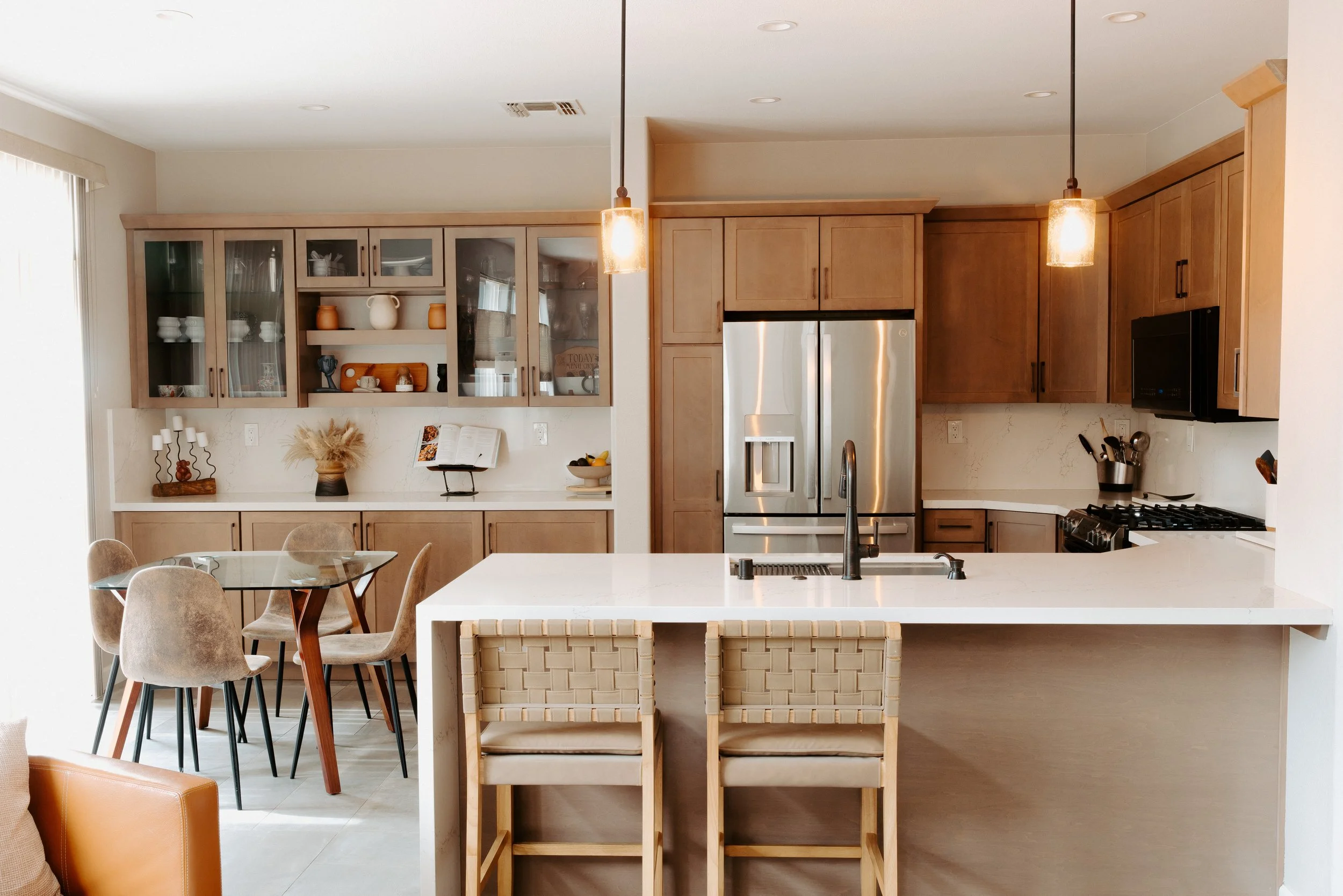
The 40–50% Cabinet Rule
A quick and practical way to begin adding up your costs is to consider the cabinets. Cabinets (including Semi-Custom cabinets such as the ones we provide from Medallion and Kraftmaid) tend to consume around 40 to 50 percent of a total kitchen remodel budget. That one number will orient everything else.
If you're working with a $70,000 budget, roughly $28,000 to $35,000 of that is going toward cabinets. The rest gets divided across countertops, labor, and everything else. If your cabinet selection pushes past that share, something else has to (better read as “should”) give. If you find ways to be efficient on cabinets, you free up room elsewhere. It's not a rigid formula, but it's a reliable starting point for understanding whether your budget and your expectations are in the same conversation.
A Quick Cost Breakdown
These proportions shift based on scope. A project with significant plumbing relocation weights heavier toward labor. Premium stone countertops pull from those percentages accordingly. But this framework is useful because it shows where the levers are before you start pulling them.
Average Kitchen Size in the East Bay
When you see cost estimates that reference an "average kitchen," it's worth knowing what that actually means in square footage terms. In the East Bay, most single-family homes have kitchens in the 150 to 250 square foot range. Anything under 150 square feet is a small kitchen. Anything over 250 starts moving into large or expanded territory.
Why it matters: cabinet counts, countertop square footage, and labor hours all scale with the size of the space. A kitchen at the upper end of average can cost 30 to 40 percent more than one at the lower end, even with identical product selections. If you're working from a budget estimate you found online, it's worth knowing where your kitchen falls on that spectrum.
Kitchen Remodel in Walnut Creek: A Real Project Example
Numbers in a chart only go so far. Here's a real project we designed for a client in the Walnut Creek area that illustrates how these costs come together, and how scope decisions affect the final number.
The client wanted to expand their kitchen by removing a wall and opening the space into their dining room, which they rarely used. The layout change gave them more linear footage along the south exterior wall for additional cabinet runs, a longer island in the center, and a peninsula. More space meant more cabinets, more storage, and more countertop. It also meant a more interesting design problem.
The final layout came in at roughly 22 linear feet of cabinetry — 19 feet along the east wall and a shorter run on the south wall — plus the island and peninsula. That footage matters when you start comparing quotes: cabinets are one of the few line items where you can do a clean per-linear-foot check across projects.
To manage cost within the expanded scope, we replaced some of the upper wall cabinets with floating shelves. Floating shelves are worth their own conversation — they have a place, and they can look great, but they tend to look better than they function for most people's actual kitchens. Here they were a sensible trade-off: they reduced cabinet count in a spot where the client was comfortable with open storage, which brought the overall cost back toward the target.
The client selected KraftMaid Knollwood in maple with a barley stain finish, which is a more refined door profile and bumped the cabinet cost modestly compared to a simpler door style. The countertop scope included four slabs of quartz: the island, the countertop runs, and a full quartz backsplash on the range wall.
Here's how the numbers broke down:
That works out to roughly $2,045 per linear foot for cabinetry alone — a useful benchmark when you're comparing quotes or sizing up your own project. Semi-custom lines like KraftMaid in this range typically run $1,800–$2,500 per linear foot depending on door style, wood species, finish, and interior accessories. Budget lines start closer to $800–$1,200; fully custom shops can push past $3,500.
For that investment, the kitchen grew by roughly 30 percent in usable space. The client got more storage, a small island as well as peninsula seating, a dedicated coffee nook, and a space that genuinely works better for both everyday cooking and hosting. The dining room they rarely used became the kitchen they use every day.
It's a meaningful number. It's also a meaningful result.
Semi-Custom and Custom Cabinet Costs: East Bay Pricing
Since cabinets are where the largest share of your budget goes, here's what different tiers typically cost for an average-sized East Bay kitchen (150 to 250 square feet). Larger kitchens, expanded layouts, or more refined door styles will push toward and beyond the upper end of these ranges, the Walnut Creek project above is a good example of that, where an expanded footprint and a premium door profile brought the KraftMaid scope to $45,000.
| Cabinet line | Approximate kitchen cost | What you're getting |
|---|---|---|
| Quality Cabinets | $8,000–$18,000 | Clean semi-custom construction, great for straightforward designs |
| KraftMaid | $18,000–$45,000+ | 100+ door styles, broad finish range, proven semi-custom quality |
| Medallion | $25,000–$55,000+ | Step-up fit and finish, inset options, traditional orientation |
| Crystal | $30,000–$65,000+ | Modern aesthetics, veneers and laminates, flexible sizing |
| True full custom | Project-specific | Any spec, any material, priced per project |
Hardware (pulls, knobs, soft-close hinges, pull-out organizers) is typically separate and adds $500 to $3,000 depending on selection and quantity. All four lines we carry use plywood box construction. If you're comparing a quote that comes in significantly lower, it's worth asking what the box material is. We cover that in more detail in our cabinet guide.
Kitchen Countertop Costs in the Bay Area
Countertop costs are one of the places where estimates from national publications will lead you astray. Good local fabricators in the East Bay are in demand, and their pricing reflects that.
| Material | Installed cost per sq ft (Bay Area) | Approx. cost for an average kitchen |
|---|---|---|
| Laminate | $20–$50 | $800–$2,000 |
| Quartz | $80–$150 | $3,200–$6,000 |
| Granite | $70–$130 | $2,800–$5,200 |
| Quartzite or marble | $100–$200+ | $4,000–$8,000+ |
These are installed costs, meaning material plus fabrication plus labor. We help coordinate countertop selection and connect you with local fabricators we trust, so that piece of the project is less of a scavenger hunt on your end.
Kitchen Remodel Labor Costs: East Bay Contractor Rates
Labor is expensive in the Bay Area. That's not a surprise to anyone who has gotten a contractor bid recently, but it's worth being direct about because it catches people off guard when they're comparing local bids to national estimates.
Beyond cost, there's a quality consideration worth stating plainly. The East Bay trades market has tightened significantly since 2020. Skilled contractors who do this kind of work well are not sitting around waiting for work. They're booked, and they charge accordingly.
Your buddy who can install a bathroom fixture might not be the right person to hang an $800-per-linear-foot designer kitchen. Cheap installation and correct installation are often mutually exclusive at that level. A misaligned cabinet run, a door that doesn't close cleanly, a countertop seam that wasn't set right; those things are expensive and disruptive to fix after the fact. In some cases they can't be fully corrected at all.
We work with a network of contractors we've vetted over many years and are happy to share those recommendations.
General labor ranges for East Bay projects:
Demo (cabinets and countertops): $800-$2,500
Plumbing relocation: $1,500-$5,000
Electrical (outlets, under-cabinet lighting): $1,000-$4,000
Tile backsplash: $15-$35 per sq ft installed
Flooring (tile or LVP): $12-$25 per sq ft installed
Kitchen Appliance Costs: A Commonly Overlooked Budget Item
Appliances are one of the most commonly overlooked line items in an initial kitchen budget, and they can move the number significantly depending on what you choose.
A basic appliance package (refrigerator, range, dishwasher, hood) from a mid-range brand runs roughly $3,000 to $6,000. A step up to professional or luxury appliances, Sub-Zero, Wolf, Thermador, Miele, changes that number fast. A 36-inch professional range alone can run $5,000 to $15,000+. A counter-depth refrigerator, which integrates more cleanly with cabinetry and is a popular choice in designed kitchens, typically costs 30 to 50 percent more than a standard-depth model. A statement range hood can be a significant design element and a significant cost.
| Appliance | Entry range | Mid-range | High end |
|---|---|---|---|
| Refrigerator (standard depth) | $1,200–$2,500 | $2,500–$5,000 | $5,000–$15,000+ |
| Refrigerator (counter depth) | $2,000–$4,000 | $4,000–$8,000 | $8,000–$20,000+ |
| Range (30") | $800–$2,000 | $2,000–$5,000 | $5,000–$15,000+ |
| Range hood | $300–$800 | $800–$3,000 | $3,000–$10,000+ |
| Dishwasher | $500–$1,000 | $1,000–$2,500 | $2,500–$5,000+ |
On timing: Appliance selection doesn't need to be finalized before the design starts. As long as you have a general sense of what you want, we can design around it and refine as the project develops. Where appliances do matter early is in anything that affects cabinet dimensions: counter-depth vs. standard-depth refrigerators, the size of your range, whether you're doing a built-in versus freestanding look. Those decisions affect how the surrounding cabinetry is designed and should be reasonably settled before the final order is placed.
Appliances typically get purchased at roughly the same time as the cabinet order, since some models carry lead times that rival cabinet production. Getting those selections locked in during the design phase keeps everything on schedule.
We have a direct referral relationship with Friedmans Appliance, a well-regarded local dealer based in Pleasant Hill. Customers we refer receive a discount on their appliance purchase. If you're not sure where to start on appliances, that's a conversation we can help you have.
Design and cabinet costs are largely a known quantity once the order is placed. Yes, there might be a scribe molding that needs to be added, or a cabinet that was sized slightly off, but those are small line items. They're fixable and they don't typically spiral. In our experience, the budget problems that become real problems almost always come from somewhere else.
In Conclusion
Contingency planning. East Bay remodels regularly surface surprises once walls come open: wiring that needs to be brought to code, subfloor damage, plumbing that wasn't where anyone expected it to be. These aren't rare edge cases; they're common enough that a 15 to 20 percent contingency should be built in from the start as a baseline assumption, not an afterthought. Customers who don't include one end up making compromises on finishes or features they care about to cover costs they didn't plan for.
Going to contractors before the design is finished. This is the one that causes the most sticker shock, and it's almost entirely avoidable.
The instinct is to get a few contractor bids early to get a sense of what the project will cost, then work out the details from there. The problem is that a contractor bidding on an undefined scope isn't giving you a budget; they're giving you a guess. You'll get a wide spread of numbers that don't represent the same project, can't be compared against each other, and won't hold once the actual design is finalized. Customers who go through this process often end up with a number in their head that has no relationship to what the real project costs, and the gap between that number and reality is where sticker shock lives
A complete design changes everything about that conversation. When a contractor can see exactly what's being installed, where every cabinet run lands, what the countertop scope is, and what trades are involved, they can bid accurately. More importantly, you can actually compare bids because everyone is pricing the same project. The design is the specification; without it, you're asking contractors to price something that doesn't exist yet.
Getting the design done first also puts you in a stronger position with contractors. You're not a homeowner with a vague idea; you're a client with a defined scope and a set of drawings. That changes the dynamic of the conversation entirely.
Poor project management once construction starts. This is where the real budget bleed happens. Change orders during construction are expensive. Decisions that weren't made before the contractor started cost more to implement mid-project than they would have cost to include in the original scope. Materials that weren't ordered on time create delays that cost money. The design and planning phase exists precisely to prevent this, and customers who rush through it pay for it later.
Cutting costs in the wrong places. When a budget needs to come down, the question is where to reduce without compromising what matters most. Sometimes that's choosing KraftMaid instead of Medallion and putting the difference toward a better countertop material. Sometimes it's phasing the project, completing the kitchen now and a butler's pantry later. Sometimes it's adjusting the layout rather than the product. There's almost always a path to the right budget; it just requires understanding the tradeoffs rather than trying to shave a percentage off the top of everything.
TL;DR
Bay Area kitchen remodels run $30,000 to $150,000+ depending on scope, size, and product selection
Cabinets typically consume 40 to 50 percent of the total budget; use that as your anchor
An average East Bay kitchen is 150 to 250 square feet; size affects every cost category
Labor is expensive here, and who you hire matters as much as what you pay them
National cost estimates don't reflect Bay Area pricing; use local numbers
Appliances are a separate budget line that people commonly forget; a basic package runs $3,000-$6,000, luxury appliances can add $20,000-$40,000+
Counter-depth fridges, professional ranges, and statement hoods are the biggest appliance cost drivers
Design before contractors; a bid on an undefined scope isn't a budget, it's a guess
Build in a 15 to 20 percent contingency before construction starts
Budget problems almost never come from cabinets; they come from poor planning, change orders, and project management
The design consultation is free and will tell you more than any article can
Schedule a Free Kitchen Design Consultation
A design consultation is where the budget conversation becomes useful. We look at your space, talk through what you want to accomplish, and give you a real picture of what it's going to take for your specific project. That conversation is free, and it will tell you more than any cost guide can.
Schedule a consultation at our San Ramon showroom and we'll come prepared.
Budget Calculator
Another note from Justin:
Use this tool to experiment with costs and build your budget according to your preferences. This tool is just for reference, but it utilizes pricing models derived from our own pricing and customer budgets. This is a real world, Bay Area focused kitchen remodel calculator, not a throw away tool posted by a large conglomerate.
For example, some cabinet companies will encourage you to use a percentage, usually defaulting to somewhere around 15%, of your homes value as a means of budgeting for your kitchen remodel. The average 3 bedroom 2 bathroom in the East Bay is $979,907 and that household income usually hovers around 200k-250k. At 15%, that means your remodel might come in at around 150k. That’s nonsense and there’s a much more realistic number to be explored here.
This calculator uses weight and averages that cater to where we live and it should help get you some realistic numbers.
Kitchen Remodel Budget Calculator
Get a realistic picture of your project cost and monthly financing before you start the design process.
Cabinets
Typically 40–50% of total project cost
Countertops
Installed cost: material + fabrication + labor (Bay Area pricing)
Appliances
Slider auto-adjusts the tier; click a tier to jump
Hardware & Miscellaneous
Knobs, pulls, hinges, organizers
Labor & Construction
Demo, installation, plumbing, electrical, tile
Structural, Design & Engineering
Moving walls, additions, engineering, permits
Estimated Project Cost
Code issues, subfloor damage, and plumbing surprises are common once walls open.
Financing Comparison
See how different products affect your monthly payment